
Perimenopause Rage: Why It Happens and What Helps
Perimenopause rage is real, and it is not who you…


I couldn’t remember the details of what our client had been talking about. I could remember the overall principles, but the details were evading me, just 5 minutes after the call ended.
Another time I couldn’t retain what I knew about the project budget, which normally I would have had front of mind. I began to question myself.
Was this just a more complicated project than normal (yes it was) or was I losing my grip on what I was used to doing effortlessly (yes it felt like it). Self doubt crept in and was soon banging around my head like a hammer.
I felt like I was alone and had nobody to confide in. After all, who wants to willingly share that they aren’t feeling as sharp as they used to and are terrified they might be losing their mind?!
As it turns out, my best friend (also a Practice Nurse) was my person to confide in. She put on her medical hat and told me very directly that she thought I was in perimenopause, and that what I was experiencing is commonly known as brain fog.
My relief was palpable. I wasn’t at the start of some kind of terrible decline, it was my physiology.
I began to research and understand the wider impact of this stage of life and soon realised that the reason I’d also been feeling so tired was attached to something called perimenopause fatigue. Everything started making sense.
If you’re reading this and recognising some of this in yourself, once you realise what’s happening, you can start to understand more about how these physiological changes affect you and what you can do about it.

The short version, if you only have a minute:
There are a number of things that can contribute to feeling more tired than you might normally, and the link between perimenopause and fatigue is a real one.
I hear many women talk about sleep deprivation. Hot flushes and night sweats disrupt the night, or a brain that won’t switch off does, that inner critic playing on your mind at 3am.
Increased levels of anxiety is something that many women talk about. This alone has the potential to keep you up at night, worrying about the small things that didn’t used to bother you.
For some women those sleep disturbances tip into full insomnia. Sleep problems at this stage are rarely one single thing, and broken nights are one of the fastest ways to flatten your energy levels the next day.
What’s important to recognise here is the very real difference between being tired after a busy day or a late night, and perimenopausal fatigue, which is often described very differently. More like an extreme fatigue that suddenly comes over you, or feeling much more overwhelmed when you normally wouldn’t.
One of the ways to think about which is affecting you is that general fatigue can usually be improved with a good night’s sleep and is in proportion to what you’ve been doing.
Crashing fatigue isn’t always relieved by sleep or a day off work. Many women describe it like ‘hitting a wall’.
| What you notice | Everyday tiredness | Perimenopause fatigue |
|---|---|---|
| After a good night’s sleep | You feel better | You can still feel tired all the time |
| How it arrives | Gradually, after a long day | Suddenly, like hitting a wall |
| Is it in proportion? | Yes, it matches what you have been doing | No, a quiet week can still floor you |
| What a day off does | Restores your energy levels | Barely touches the low energy |
| What comes with it | Not much else | Fog, low mood and anxiety, mood swings, weight gain and other symptoms |
| What helps | Sleep and rest | Adjustments at work and at home, and support from others |
This type of fatigue can be linked to the hormonal changes of perimenopause, the changing levels of oestrogen and progesterone.
Those changing levels affect sleep, mood and how your body handles pressure, so cortisol levels can stay higher than they should when you are already short on rest. Your stress hormone was never designed to run all day.
Those swings can also bring low mood and anxiety, mood swings, weight gain and feeling irritable, so exhaustion is rarely travelling on its own. It can be made worse by some of the things already mentioned, generally making it much harder both mentally and physically to get through the day.
The key here is to realise that none of this is a personal failing. You need adjustments to your life both at work and at home, rather than doing what most women are used to, which is to keep pushing through.
Talking to people you trust or are close to can help you feel less alone, and can help you work out how to put some of these adjustments in place yourself. These might look like implementing boundaries to protect your time and energy.
Support from others is essential. So is self care that you take seriously rather than fit in around everybody else.
If this is affecting you in more severe ways or you’re worried, then do speak to your doctor so they can help you explore what may be contributing.

A GP can check for other things that cause fatigue, such as thyroid problems, iron deficiency or chronic fatigue syndrome, and talk through whether taking HRT would help you and how it fits with your overall health. They will probably raise lifestyle changes too: regular exercise and strength training in particular, physical activity that fits the energy you have, and a wind-down routine to improve sleep quality and steady your circadian rhythm.
If you want the fuller picture of what this stage of life does to your sense of self, this is the ground we cover in reclaiming your power in perimenopause.
One of the most common effects of perimenopausal symptoms that we hear about, and sadly one that is almost universal for women who experience any of them, is self doubt.
When self doubt creeps in, it naturally starts to undermine confidence. You second guess your thoughts, forget a word you always use, try to remember whether you have already done something, or worry about what you said and whether it was right after all.
We call it a self doubt spiral because if it’s not caught in time, that’s exactly what it becomes.
The brain has a tendency towards negativity bias, which means it’s naturally wired to overly examine the negative aspects of life and see them in glorious technicolour.
This automatically dilutes more positive thoughts and puts most of the attention on more unhelpful thoughts, which impacts confidence when we most need it.
For many women in the workplace, this is yet another thing that can impact perceived performance and ability.
We know this isn’t the case, but under pressure and without adjustments or, crucially, manager and colleagues understanding, it can be seen as a lack of competence.

When we are already feeling the impacts of the fog, concern from others can further impact how we feel about ourselves. Before we know it, we are telling ourselves a story that isn’t true.
Any natural doubts are magnified, any existing feelings of imposter syndrome rise up, and you might start to wonder if you’re still good enough. If you also have ADHD, the two amplify each other, which we unpick in ADHD and perimenopause symptoms in women.
This isn’t something we need to ‘put up with’ and isn’t something that needs to be accepted as ‘just what happens’.
The good news is there are many things we can do to support ourselves, and that can be done collectively with others.
First it’s important to recognise that self doubt is a common symptom of menopause and the years leading up to it, not a personal failing or an individual issue.
During this transition the body is recalibrating, and that affects the brain chemistry linked to confidence, focus and motivation.
Oestrogen, testosterone and progesterone play key roles in mood regulation and cognitive function. When they fluctuate, it can often feel like you don’t recognise yourself!
The great news is that this isn’t permanent. As always, by understanding why this is happening we can start to make sense of it and then take action to rebuild even stronger and stop misinterpreting what’s going on.
Now you understand what’s happening in your body, let’s look at ways to interrupt this and stop it from becoming a pattern, because the brain loves patterns and things that become familiar. It makes it much easier for it to be lazy and use a default system of ‘go to’ thoughts and behaviours.
These next points are about protecting your confidence and sense of self.
As a capable individual who is navigating a period of change, fog can make you question your capability.
The answer isn’t to work harder to prove you’re still capable. It’s to put practical strategies around yourself so that your capability has room to show up.
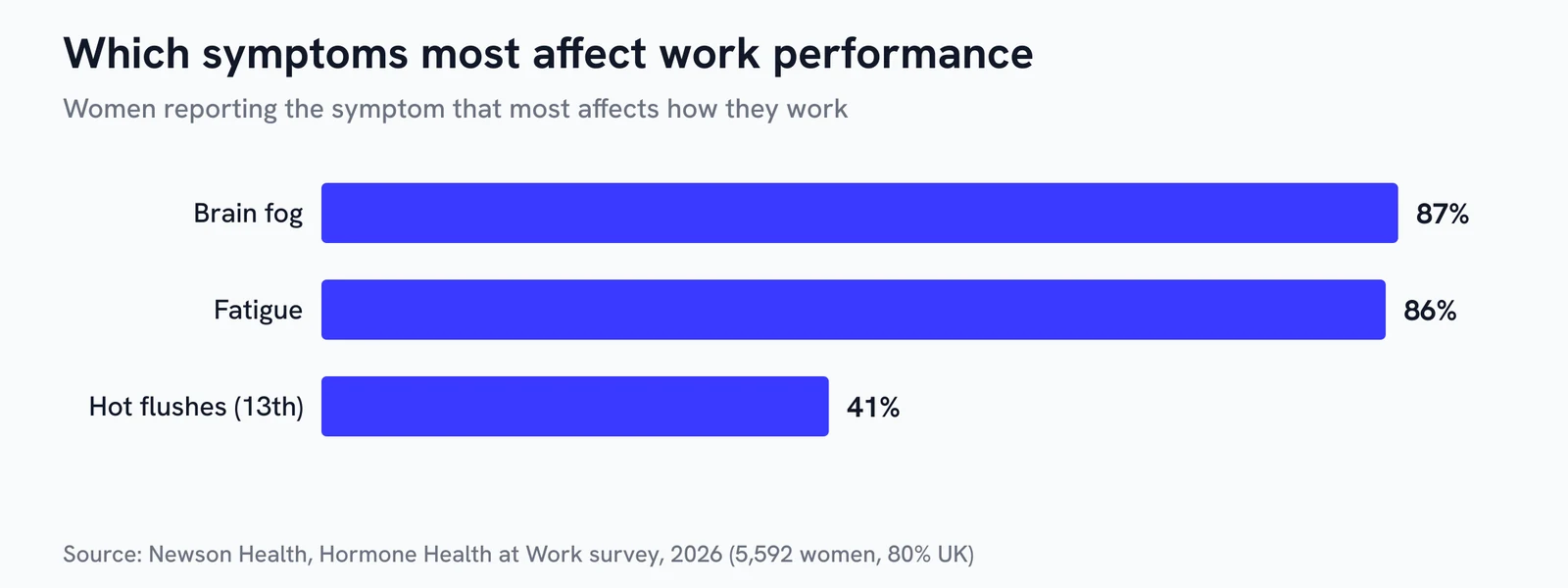
This matters for more than one day at a time. When 5,592 women were asked which symptom most affected their work, brain fog came first at 87% and fatigue second at 86%.
Hot flushes, the symptom everyone pictures, ranked thirteenth. The parts of perimenopause and menopause that really derail a working day are the ones nobody can see.
You don’t need to put all of these in place, just choose what works best for you. Here are some practical ways to reduce menopause fatigue and confidence dips at work.
When the fog affects working memory, you may find it harder to hold onto information, remember what was said in a meeting, or keep track of several things at once. This can be particularly unsettling if you’re used to being highly capable and reliable.
Actions someone can take:

The important shift is this: don’t judge yourself for needing to remember differently. Build a system that remembers for you.
Fog and self doubt can make meetings feel more exposing. You might know your stuff but struggle to find the right words quickly, lose your train of thought, or leave the meeting thinking, “Why didn’t I say that?”
Actions someone can take:
This isn’t about appearing less capable. It is about giving your brain the conditions it needs to perform at its best.
This stage can bring fluctuating energy, concentration and mental clarity. One day you might feel completely on it; another day the same workload can feel much harder, and that unpredictability can feed self doubt.
Energy mapping means noticing when and how you work best, then using that information deliberately. It is the most reliable way I know to boost your energy levels without simply demanding more of yourself.
Actions someone can take:
The confidence-building part is important: you start to see patterns rather than concluding, “I’m not as good at my job anymore.”
If you want a fuller structure to hang this on, here is the framework that rebuilt my confidence during perimenopause.
There can be a difficult question underneath all of this. Should I tell my manager or colleagues what I am experiencing?
There isn’t one right answer. Disclosure should be a choice, not an obligation.
Actions someone can take:
A useful question is: “What would make work easier for me right now, and who needs to know in order for that to happen?”
None of this is something you have to work out on your own. It is exactly what confidence coaching for women is for.
As with all symptoms at this stage, it’s a completely individual experience for each woman. Some people experience a lot of them, while others might not notice any changes.
Perimenopause fatigue normally eases as things settle. The crucial thing is recognising changes and moving forward with something that will support you during this stage, and if the lack of energy is not shifting, talk to your doctor.
Fluctuating oestrogen can affect brain systems involved in memory, attention and concentration, which can make thinking feel slower or less reliable. For most menopausal women these cognitive symptoms improve as hormones settle, although the timing varies.
Importantly, experiencing this doesn’t mean you’re losing your cognitive ability or developing dementia.
This is an individual decision. For more help with it, see the disclosure decision above.
If this is where you are, The Confidence Gym was built for you. See how group coaching works, and take a look at our Perimenopause Confidence Retreat.