
Perimenopause Fatigue and Brain Fog at Work: What Helps
Perimenopause fatigue and brain fog at work are not a…


Imagine this. You’re in your late 30s or early 40s, juggling a career, family and relationships, and suddenly everything feels harder.
You’re forgetting appointments, losing your words mid-sentence, and your moods are swinging like a metronome on overdrive.
You wonder, is this burnout? Early dementia? Or am I just losing the plot?
The answer might be something no one told you about: ADHD and perimenopause. For many women, especially those with undiagnosed ADHD, the overlap of these two life phases can feel like the rug is being pulled out from under them.
ADHD and perimenopause symptoms in women are too often misunderstood. While this transition changes your hormone levels, ADHD can amplify emotional and cognitive struggles, especially for women who never knew they had it.
This blog explores 10 ways these symptoms collide, and how understanding the connection between ADHD and hormones could be the key to reclaiming your brilliance.
The short version, if you only have a minute:
ADHD in women often flies under the radar. We weren’t the kids bouncing off the classroom walls.
We were the daydreamers, the doodlers, the ones who seemed fine but always felt one step behind. Many women don’t get diagnosed until adulthood, sometimes not until this stage of life sets in and everything gets that much harder.
The traditional stereotype of attention deficit hyperactivity disorder, hyperactive boys who can’t sit still, doesn’t reflect how the condition presents in most women. Our symptoms often look like chronic disorganisation, emotional sensitivity, and exhaustion from years of masking.
Inattention rather than hyperactivity is the more common picture, and hyperactivity disorder in girls is missed for exactly that reason. It is a neurodevelopmental condition that runs across the lifespan, not a childhood phase.
Women with ADHD are more likely to internalise their struggles.
Instead of acting out, we people-please. We mask. We overcompensate.
But masking comes at a cost: exhaustion, shame, and self-doubt. And then perimenopause hits.
This is a natural transition that affects every system in your body, including your brain. Oestrogen, which helps regulate dopamine, a key neurotransmitter for attention and mood, starts to fluctuate and decline.
Why does this matter? Because dopamine is central to executive function, the part of the brain responsible for focus, memory, motivation and emotional regulation.
When oestrogen levels drop, it struggles to stay balanced. For neurodivergent brains, this imbalance is amplified, and the hormonal changes exacerbate ADHD traits that were previously manageable.
In practical terms, things you once managed through routine or structure now feel impossible. The coping strategies that once worked start to crumble, and daily life feels harder than it ever did.
Here’s where it gets especially confusing. The two share many symptoms, and when they overlap it can be hard to distinguish the root cause.
Common overlapping symptoms include:
Many women are told this is just hormones, and the exhaustion that comes with it gets the same treatment. We wrote about that separately in perimenopause fatigue and brain fog at work. But if you’ve been living with undiagnosed ADHD, what you’re experiencing could be a double hit to your executive function, and you deserve support that reflects that.
The table below is the one I wish someone had handed me. It won’t diagnose you, but it will help you work out which conversation to start.
| What you’re noticing | Points more to ADHD | Points more to perimenopause |
|---|---|---|
| Forgetfulness | Lifelong. You have always lost keys and threads | New in your 40s, and worse in the days before your period |
| Difficulty focusing | Present since school, masked by sheer effort | Arrived recently, alongside broken sleep and low mood |
| Emotional dysregulation | Fast, intense, and quick to pass | Tearfulness and irritability that track your cycle |
| Fatigue | Comes from masking and mental overload | Physical symptoms too, like night sweats and waking at 3am |
| Mental fog | Worse when you are bored or overwhelmed | Worse as oestrogen levels swing |
| Decision paralysis | Familiar. You already have workarounds | New, and your old workarounds stopped working |
For many women, this is the moment where the mask slips. The strategies that kept them functioning begin to fail.
Suddenly, life feels harder in ways that are hard to articulate, but deeply felt. If anger is the part that frightens you most, perimenopause mood swings covers that ground.
As Margaret Reed Roberts shared in Dr Louise Newson’s podcast, perimenopause made her undiagnosed ADHD unbearable. For the first time, she couldn’t hold it together, and the emotional toll was immense.
Many women in their 40s and 50s are misdiagnosed with anxiety or depression. They’re prescribed medication that doesn’t address the root issue.
They’re told it’s stress or hormones, but not ADHD. Without proper diagnosis or support, the risk of burnout, relationship strain and job loss increases.
Here are some ways this might show up in your life.
“It felt like my brain had been tossed into a washing machine, and all of the delicate bits that made it sparkle had dissolved. Everything took three times longer than it should have.” Noelle Faulkner, The Guardian
These are not personality flaws. They are symptoms of a neurochemical shift.
“This isn’t about being forgetful, it’s about your brain chemistry shifting under your feet.” EmpowerHer
For some, an ADHD diagnosis in midlife feels like a revelation. For others, it’s more about self-recognition, finally putting language to what you’ve always felt.
Diagnosis isn’t about labelling, it’s about liberation. It allows you to reframe your past and adjust your present.
It gives you permission to stop beating yourself up for things your brain wasn’t wired to do easily.
Reading books like You Mean I’m Not Lazy, Stupid or Crazy?! by Kate Kelly and Peggy Ramundo, or Women with Attention Deficit Disorder by Sari Solden, can be transformative. These works validate the female experience and offer real-world tools for managing ADHD day to day.
Self-awareness can also shift how you advocate for yourself in healthcare, the workplace and your relationships. You stop minimising your needs, and start meeting them.

If your symptoms have intensified with age, HRT might be worth exploring. Rebalancing oestrogen can help steady those levels and support better cognitive function.
It’s not a magic fix, but many women report noticeable improvements in clarity, mood and focus.
Working with a practitioner who understands both this transition and ADHD is key. If you’re dismissed, keep going. You deserve better care.
Remember: ADHD is a dopamine-regulation condition, and oestrogen directly influences dopamine. It’s all connected.
If you receive a diagnosis, medication might be offered. While not for everyone, stimulants like methylphenidate (Ritalin) or amphetamines (Elvanse) can enhance focus, reduce overwhelm, and improve your ability to follow through.
When combined with therapy, coaching or support groups, ADHD treatment becomes part of a wider toolkit. Not a cure-all, but a powerful ally.
Important note: ADHD medication is often under-prescribed for women, especially midlife women. Don’t let that deter you. Your needs are valid.
Confidence coaching supports you to navigate this messy middle with intention. At EmpowerHer, we’ve worked with hundreds of women navigating perimenopause, ADHD, or both.
Our Brilliance Blueprint™ coaching programme blends creative tools with neuroscience-backed strategies. We help you:
If confidence is the piece that has taken the hardest knock, that is the whole subject of our guide to confidence coaching for women.
“Brilliance never pauses, and neither does your potential.” EmpowerHer
The shame of struggling in silence keeps us stuck. The antidote? Connection.
Whether it’s through a coaching circle, a WhatsApp group, or a podcast that finally makes you feel seen, community transforms isolation into empowerment.
Find spaces that honour your lived experience. Read books by women who’ve walked this path. Join conversations that reflect your truth.
You don’t have to do this alone. And you shouldn’t.
| The myth | What is really going on |
|---|---|
| “ADHD is a childhood disorder.” | It is lifelong. In women it is simply masked until midlife. |
| “Menopause only causes hot flushes.” | Cognitive and emotional shifts are major menopausal symptoms too. |
| “ADHD is overdiagnosed.” | In women it is massively underdiagnosed, especially the inattentive type. |
| “Hormones don’t affect ADHD.” | Oestrogen directly influences dopamine, which is core to ADHD regulation. |

Many women report a decline in workplace confidence at this stage. Add ADHD into the mix and it’s no surprise that productivity, time management and performance suffer.
Common challenges:
These are not signs of incompetence. They are signs you need tailored support. Without it, the result is often a crash in self-confidence and low mood.
The scale of it is easy to underestimate. Across a survey of 5,592 women, a quarter had avoided applying for a promotion and one in six had given up a job outright because of their symptoms.
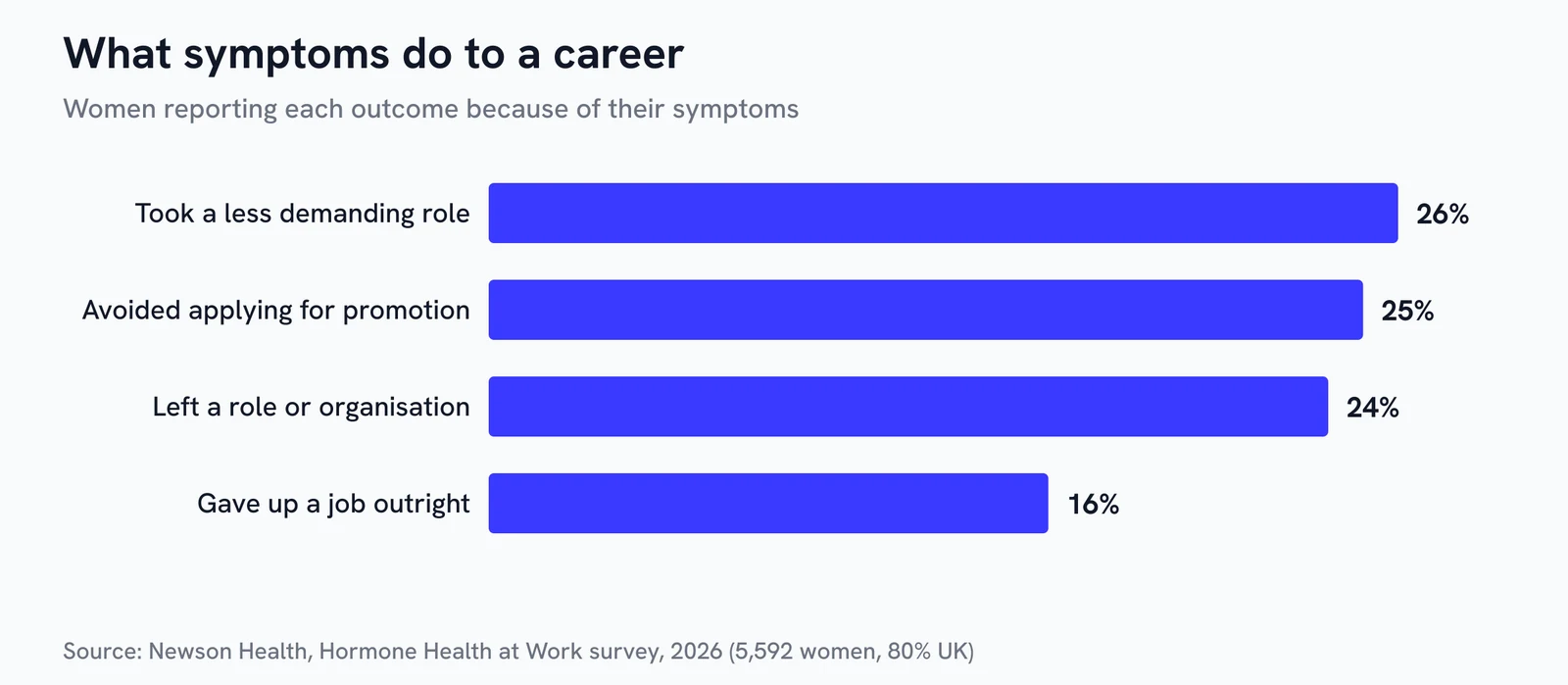
Most workplaces don’t connect these dots. EmpowerHer is passionate about providing support and creating lasting change, and through our coaching and knowledge sharing we help women remain confident and successful in their roles.
The fatigue and fog side of this deserves its own read, which is why we wrote about perimenopause fatigue and brain fog at work.
Jess was 44 when she hit a wall. A high-achieving creative director and mum of two, she had always relied on lists, caffeine and late nights to stay on top of things.
But now, her brain felt scrambled. She would walk into rooms and forget why.
Meetings left her anxious and teary. Her once-reliable memory felt like Swiss cheese.
“I thought I was losing my mind,” she said. “Nothing I did worked anymore. I was terrified I’d get fired.”
After hearing a podcast on ADHD in women, something clicked. She pursued an assessment and received a late diagnosis. That moment changed everything.
With medication, confidence coaching and hormone therapy, Jess rebuilt her systems and self-trust. “I’m still me,” she says, “but with less shame and a whole lot more self-understanding.”
Her story is not unusual. It’s the quiet revolution happening in women’s health, if we start naming it.
Yes, and this is the question we are asked most. ADHD itself does not change, but the conditions it operates in do.
Falling oestrogen destabilises the brain chemistry that focus and emotional regulation depend on, so existing ADHD symptoms can feel considerably more impairing. Many women describe the years leading up to menopause as the hardest of their lives, and it is not because they suddenly became less capable.
Rarely like the stereotype. It looks like chronic overwhelm, a house full of half-finished projects, a calendar you no longer trust, and a growing dread of admin.
It often looks like a woman who is performing well on paper and exhausted underneath, because holding it together takes everything she has. Physical symptoms such as poor sleep and restlessness sit alongside the cognitive ones.
Completely. Symptoms of perimenopause commonly begin in the early 40s and sometimes in the late 30s, which is exactly why so many women mistake them for stress or burnout.
If your symptoms started earlier than you expected, that is worth raising with your GP rather than dismissing.
There isn’t a single best one, and we are coaches rather than clinicians, so this is a conversation for a doctor who understands both.
What is worth knowing is that some women find their usual medication works less predictably as hormone levels swing, and that treating the hormonal side and the ADHD side together tends to work better than either alone.
These symptoms don’t just add up, they multiply. For many women, this collision brings years of missed diagnoses, internalised shame and confusion.
Whether you’ve lived with ADHD your whole life, or you’re just starting to recognise it now, understanding this moment in your life is powerful.
You deserve clarity. You deserve support. And you’re not alone.
This has long been an underexplored combination. But the more we talk about it, and about the symptoms the two create together, the more we open doors for care, self-trust and brilliant new beginnings.
If you want the wider picture, read how our co-founder built a framework that rebuilt her confidence.
Because your brilliance never pauses, Amy xx
Know someone who needs this? Share the blog.
Want to learn how EmpowerHer can support your workplace? Schedule a discovery call, or see how group coaching works.